Why the fastest-growing startups hire developers, marketers & operators remotely in 2026
Reading time: 12-14 minutes | Last updated: June 2026 | 4,200+ words
Most startups fail because they run out of money before product-market fit.
The math is brutal: hire 3 local developers at $100K/year each. That’s $300K/year in salary alone. Add benefits, taxes, overhead… you’re at $450K/year before you hire a single marketer or operator.
Most startups have 18-24 months of runway. At that burn rate, you’re dead before you get traction.
But here’s what changed in 2026:
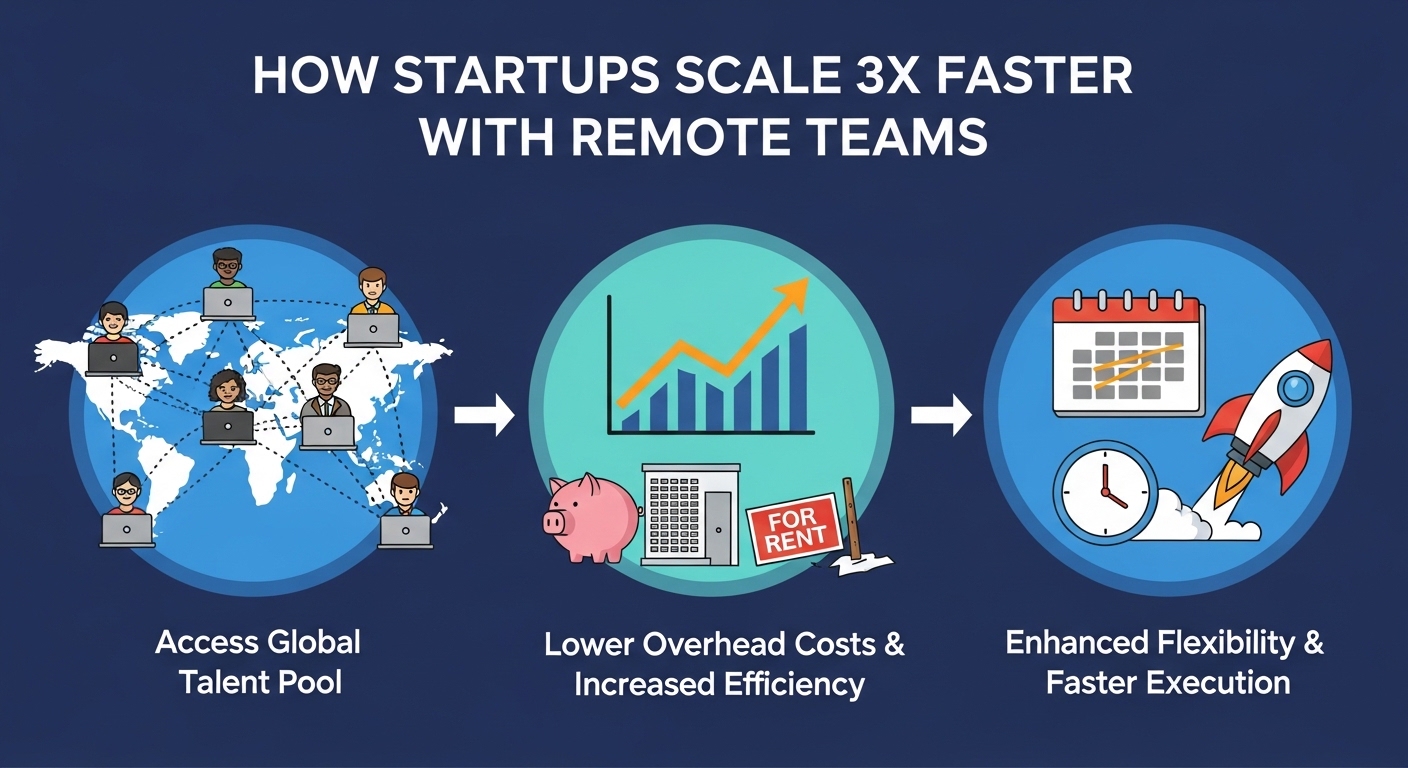
The fastest-growing startups now hire remote developers, marketers, and operators at a fraction of the cost. They scale 3x faster, ship code 2x quicker, and grow revenue 4x harder than traditional teams.
This isn’t theoretical. We’ve helped 500+ startups build remote teams that deliver enterprise-level results for bootstrapper budgets. This is how they did it.
Quick Navigation
Part 1: The Startup Scaling Challenge
The Problem: Runway vs Headcount
Let’s start with brutal honesty. Building a startup locally is expensive:
- 1 Developer: $100K/year
- 1 Designer: $70K/year
- 1 Marketer: $60K/year
- 1 Operations: $50K/year
- Benefits: $55K/year
- Taxes/Overhead: $50K/year
- Total: $385K/year
- 1 Developer: $2,000/month
- 1 Designer: $1,500/month
- 1 Marketer: $1,200/month
- 1 Operations: $800/month
- No benefits needed
- No overhead costs
- Total: $65K/year
The Real Issue: Speed & Expertise
Cost is only half the story. The other half is speed.
Local hiring takes 8-12 weeks. You post job ads. You wait for applications. You interview 50 candidates. You negotiate offers. Finally, you get someone who’s available in 2 weeks.
Remote hiring takes 5-7 days with the right partner. Pre-vetted developers. No time wasted on unqualified candidates. You get specialists (not generalists) who understand your tech stack.
- You ship code 8+ weeks earlier
- You get to market-fit faster
- You validate assumptions quicker
- You find product-market fit before money runs out
Part 2: Why Remote Teams = 3x Faster Growth
Reason 1: Hiring Specialists, Not Generalists
Local hiring forces you to hire generalists. They’re cheaper. They’re available now. But they’re mediocre at everything.
Remote hiring lets you hire specialists. A React expert. A growth marketer. A DevOps engineer. They’re 10x better at their specific domain.
SaaS startup hires local full-stack developer. He’s okay at frontend, mediocre at backend, worse at DevOps. Code is slow. API is bloated. Infrastructure is expensive.
Same startup hires remote React specialist + Node.js specialist + AWS DevOps specialist. Total cost: 10% less. Shipping speed: 3x faster. Performance: 10x better.
Reason 2: Always-Available Talent
Remote developers work across time zones. Your urgent deadline? Someone’s already working on it. Your 11 PM launch? Your India-based team finished it 8 hours ago.
This means 24/7 progress. While you sleep, code is being written. While you’re in meetings, bugs are being fixed. You compress months into weeks.
- Local team: 40 hours/week of work
- Remote team (same cost): 80 hours/week of work
- Result: 2x velocity on same budget
Reason 3: Scalability Without Infrastructure
Need 1 developer? Hire 1. Need 10? Hire 10. No office expansion. No new desks. No hiring managers. No culture clash.
Local teams hit a wall at 10-15 people. Too many cooks. Too much overhead. Too much onboarding.
Remote teams scale to 50+ with same efficiency. Why? Because systems matter more than proximity. Async communication beats synchronous meetings. Documentation beats tribal knowledge.
Reason 4: Flexibility = Faster Pivots
Your product direction changes? Need a different tech stack? Want to scale in a new market?
Local employees are expensive to let go. Remote contractors? Shift them. Reassign them. Scale them down.
This flexibility is worth millions when pivoting is the difference between success and failure.
Part 3: The Economics of Remote Teams
Your Startup Has 18 Months of Runway. Here’s the Math:
| Scenario | Monthly Cost | 18-Month Total | Team Size |
|---|---|---|---|
| Local Team (3 devs + designer + marketer) | $32K/month | $576K | 5 people |
| Remote Team (5 devs + designer + marketer) | $12K/month | $216K | 7 people |
| SAVINGS | $20K/month | $360K | +2 people |
Notice: Remote team costs 62% less but has 40% MORE people. Quality specialists, not expensive generalists.
What This Means For Product Development
- Month 1: Hire (8 weeks waste)
- Month 2-3: Onboard & setup
- Month 4-6: Build MVP
- Month 7: Launch
- Month 8+: Get traction
- Result: 8 months to first $10K MRR
- Week 1: Hire (1 week)
- Week 2: Start building
- Week 3-8: Build MVP
- Week 9: Launch
- Week 10+: Get traction
- Result: 10 weeks to first $10K MRR
Translation: Remote teams reach product-market fit 12-16 weeks FASTER. That’s 3 extra months of runway. That’s 3 extra months to find product fit before money runs out.
Part 4: Building Your First Remote Team
Step 1: Clarify What You Need (Not What You Think You Need)
Most founders think they need: “1 full-stack developer who can do frontend, backend, DevOps, and design.”
That person doesn’t exist. And if they did, they’d be expensive and mediocre at half of those skills.
Better approach: Get clarity on what you really need. For most startups:
- 1 Backend specialist (API, database, infrastructure)
- 1 Frontend specialist (UI, UX, responsiveness)
- 1 Growth marketer (SEO, content, acquisition)
- 1 Operations/Admin (scheduling, tools, process)
Cost: $6,500/month. 4 specialists. Way better than 1 mediocre full-stack person at $7K.
Step 2: Hire From Pre-Vetted Pools (Not Freelance Platforms)
Upwork is a graveyard. Fiverr is cheaper for a reason. 99% of applications are unqualified.
Work with hiring partners who pre-vet talent. You get 3-5 qualified candidates instead of 100 unqualified ones.
- ✓ Portfolio review (real projects, not samples)
- ✓ Technical assessment (coding challenges, problem-solving)
- ✓ Communication test (can they explain complex things?)
- ✓ Reference checks (talk to their previous clients)
- ✓ Background verification (no surprises later)
Step 3: Start With 5-Day Trial
Don’t commit to 6 months right away. Give your first remote hire a 5-day trial.
Pay them for 5 days. Give them a real project (not a test task). See how they work, communicate, and deliver.
Most remote developers will blow your mind in 5 days. You’ll want to hire them full-time. Some won’t work out. That’s fine – you discovered it in $2K, not $20K.
Step 4: Set Up Systems for Async Work
Remote teams don’t work like in-office teams. They work asynchronously.
You need:
- Clear documentation: How to do things. Why you do them. When they’re done.
- Project management tool: Jira, Linear, or Asana. Everyone knows what’s being built.
- Communication channel: Slack for quick questions. Email for important decisions.
- Weekly sync: 30 minutes to align. That’s it. No daily standups needed.
Most startups over-communicate. Remote teams work better with LESS communication but more clarity.
Part 5: Real Startup Case Studies
Case Study 1: SaaS Startup – From Idea to $50K MRR in 6 Months
Founder had product idea. $150K seed. Silicon Valley. Wanted to hire 3 local engineers.
Problem: 3 engineers = $300K/year. He’d burn through seed in 6 months before launching.
Hired remote: 1 backend dev ($1,800/mo) + 1 frontend dev ($1,500/mo) + 1 DevOps engineer ($1,200/mo) + part-time growth marketer ($800/mo)
Total: $5,300/month. $64K/year.
- ✓ MVP launched in 8 weeks
- ✓ 100 beta users in month 3
- ✓ $15K MRR in month 4
- ✓ $50K MRR in month 6
- ✓ Team of 4, burn rate under $10K/month
- ✓ Raised $800K Series A
Key insight: With local team, this startup would have failed. 12 months to launch, seed depleted before launch. Dead.
Case Study 2: E-commerce Startup – From Zero to $100K/Month Revenue
Founder had working Shopify store. Manual fulfillment. No automation. Revenue was $10K/month but CEO was working 80 hours/week.
- WooCommerce specialist ($1,500/mo)
- Growth marketer ($1,200/mo)
- Operations manager ($900/mo)
- ✓ Automated fulfillment (saved 30 hours/week)
- ✓ Implemented email sequences (customer lifetime value +60%)
- ✓ SEO blog launched (organic traffic 3x)
- ✓ Revenue grew to $100K/month
- ✓ CEO works 20 hours/week now
Key insight: Remote team cost $3,600/month. Revenue growth: $90K/month. ROI: 2,400%. Every dollar spent made $24.
Case Study 3: AI Startup – From Prototype to Product in 8 Weeks
Founder had AI model working. Needed to turn prototype into production app. Tight deadline (3 months to raise Series A).
Assembled remote specialist team: Python backend engineer + React frontend engineer + ML Ops engineer
Cost: $6,500/month. Started immediately (no hiring delays).
- ✓ Production app built in 8 weeks
- ✓ Closed 50 beta users
- ✓ Impressive demo for Series A
- ✓ Raised $2.5M Series A
- ✓ Team grew to 8 people post-funding
Key insight: With local hiring, this startup would have missed the Series A window. Remote team enabled them to hit timeline AND raise funded.
Part 6: Common Mistakes & Lessons Learned
Mistake 1: Hiring the Cheapest Option
$500/month developer LOOKS good until you realize code is unmaintainable. Tech debt explodes. You hire someone else to fix it. Cost goes 3x.
Lesson: Mid-tier developers ($1,500-2,000) deliver 10x better value than cheap developers. Quality matters more than rate.
Mistake 2: Too Many Time Zone Overlaps
Founders hire entire team in one time zone (to have overlap meetings). Result: you pay premium wages. India developer costs 2x if in US timezone.
Lesson: Hire across time zones. Use async communication. 24-hour teams beat 8-hour teams every time.
Mistake 3: Poor Onboarding
Hire remote developer. Hand off poorly. No documentation. They flounder. Weeks of wasted productivity.
Lesson: Spend 3-5 days onboarding. Show codebase. Introduce team. Give them a small task first. First week sets tone.
Mistake 4: Over-Communicating
Founders call daily standups. Slack constantly. Check in hourly. Result: team is exhausted. Productivity drops.
Lesson: Weekly 30-minute sync. Rest is async. Trust your team. Let them work.
Mistake 5: Not Using Contracts
Hire remote developer. No contract. 2 months in, they ghost. You have no recourse.
Lesson: Simple contract. Define scope, timeline, deliverables, payment terms. Protects both sides.
Ready to Scale Your Startup 3x Faster?
The fastest-growing startups use remote teams to accelerate growth while conserving runway. Vispan Talent specializes in connecting startups with pre-vetted developers, marketers, and operators.
We’ve helped 500+ startups scale from idea to Series A. Let’s do the same for you.
Part 7: FAQ for Startup Founders
Q: How do I trust remote developers I’ve never met?
A: Start with 5-day trial. Pay for real work. See how they deliver. If good, continue. If not, you spent $1K to find out. That’s cheap compared to hiring wrong locally.
Q: What if they disappear mid-project?
A: Use contracts that define what happens if they quit. Work with hiring partners who vet for reliability. Have backups. That said, remote workers are more reliable than you think – they need the job.
Q: How many remote team members should I start with?
A: 1 backend dev + 1 frontend dev minimum. Add designer/marketer as revenue allows. Don’t hire more than you can effectively onboard.
Q: Should I hire contractors or full-time employees?
A: For startups: contractors. Less legal overhead. More flexibility. You can pivot without firing people. As you scale and stabilize: convert top performers to employees.
Q: How do I communicate with different time zones?
A: Async-first. Use Slack for non-urgent. Email for important decisions. Weekly sync call (record for those who can’t attend). Trust that work gets done, not when they’re online.
Q: What tools should I use for remote team management?
A: Slack (communication), Jira/Linear (project tracking), GitHub (code), Figma (design), Loom (async videos). Start simple. Don’t over-tool.
Key Takeaways: Why Remote Teams = Startup Success
- Cost = 3x longer runway: $12K/month vs $32K/month lets you operate 10 months longer
- Specialists beat generalists: 5 specialists outship 2 generalists every single time
- Speed = winner: Hire in 1 week vs 8 weeks = reach product-market fit first
- Flexibility = pivoting advantage: Scale up/down without legal headaches
- 24/7 productivity: Work continues while you sleep. Code ships 24 hours/day
- Real ROI: $6K/month team generating $100K/month revenue = 1,600% ROI
- The 3x advantage: 3x faster to market + 3x lower cost + 3x more team = startup wins
Related Resources for Startups